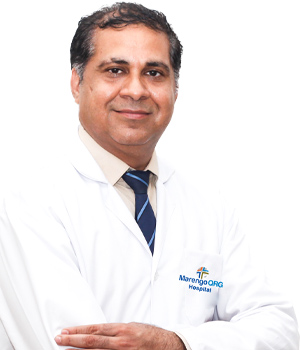
Program Clinical Director Dr. Tarun Sharma has more than 18 years of experience in neurosurgery and has practised in Faridabad for the last 12 years. Before that, he taught as an Assistant Professor of Neurosurgery at Indira Gandhi Medical College, Shimla, and worked as a consultant at hospitals across North India. A scan that shows something in the brain or spine is among the most frightening reports a family can receive, and the first question is usually whether surgery is really needed. Neurosurgeon Dr. Tarun Sharma in Faridabad takes time over that question, explaining what the scan shows, what the options are, and what each one involves, in plain words.
Qualifications
- MBBS, G.R. Medical College, Jivaji University (1999)
- MS (General Surgery), S.S. Medical College, Rewa, APS University (2004)
- MCh (Neurosurgery), PGIMER, Chandigarh (2008)
- Fellowship in Clinical Neuro-Oncology, Toronto Western Hospital, University of Toronto, Canada
- Visiting Fellowship in Paediatric Neurosurgery, Hospital for Sick Children, Toronto, Canada
Areas of Expertise
- Brain Tumour Surgery, including Awake Craniotomy
- Skull Base Tumour Surgery
- Endoscopic and Stereotactic Neurosurgery
- Minimally Invasive Brain and Spine Surgery
- Complex Spinal Reconstruction, including Transthoracic and Transabdominal Approaches
- Kyphoscoliosis Correction
- Paediatric Neurosurgery
- Brain and Spine Surgery
Career Highlights
- Assistant Professor of Neurosurgery, Indira Gandhi Medical College, Shimla
- Consultant Neurosurgeon at hospitals across North India
- In practice in Faridabad for the last 12 years
- Program Clinical Director, Neurosurgery, Marengo Asia Hospitals, Faridabad
- Author of publications and book chapters in neurosurgery
Do You Need an Operation or Just a Second Look
A frightening scan does not always mean surgery. Some growths are watched with repeat scans, some bleeds settle with medicines and intensive care, and many spine problems improve with rest and physiotherapy. If you have typed Neurosurgeon near me Faridabad into a search box after a scan or a sudden illness, bring the actual films and every report to one consultation. A neurosurgeon can tell you what needs action now, what can wait, and what can be treated without an operation.
Training in Chandigarh and Toronto
After his MCh at PGIMER, Chandigarh, he spent time in Toronto on a clinical fellowship in neuro-oncology, the care of brain and nervous system tumours, and later on a visiting fellowship in paediatric neurosurgery at the Hospital for Sick Children. Those years shaped two parts of his practice: the careful planning of brain tumour surgery and the particular care that children need.
What Your First Consultation Looks Like
A consultation with Dr. Tarun Sharma begins with a conversation about your symptoms, when they started, whether they are getting worse, any recent injury, your medical history and the medicines you take, especially blood thinners. He will check your alertness, speech, vision, strength, sensation, reflexes, and balance, and go through your CT or MRI scans. Please bring the actual films or discs along with the reports, and a family member who can listen with you.
Symptoms That Deserve a Scan
A headache that keeps getting worse or wakes you at night, repeated vomiting, a first seizure, changes in vision, speech or balance, new weakness or numbness, memory or personality changes, and persistent neck or back pain with tingling, weakness or loss of control over urine or stool all need a proper check. Many have simple causes, but they should not be handled with painkillers for weeks while the cause stays unknown.
Brain Tumours in Plain Words
A brain tumour is a growth in or around the brain. Some grow slowly and are not cancerous; others grow faster, and some spread from cancers elsewhere in the body. Symptoms depend on where the tumour sits and may include headaches, seizures, changes in vision or speech, weakness and memory problems. An MRI is usually the first step. Treatment may involve surgery, radiation, medicines or a combination, planned with other specialists. Ask about the aim of the operation, the risks to speech, movement and thinking, and what recovery will look like.
Surgery While You Are Awake
For tumours near the areas that control speech or movement, the surgeon may do an awake craniotomy. The scalp and skull are numbed and, during the key part of the operation, the patient is woken so that the team can test speech and movement while the tumour is removed. This helps the surgeon to protect those functions as far as possible. It is not for everyone, and it needs careful selection, preparation and a calm, experienced team. Dr. Sharma has a special interest in this approach, and he will explain whether it suits you, what you will feel and what the risks are.
Tumours at the Base of the Skull
The skull base is the floor of the skull, where nerves and blood vessels pass through a crowded space. Growths here can cause hearing loss, ringing in the ear, facial numbness, double vision, trouble swallowing or a hoarse voice. Because they sit close to vital structures, they need detailed imaging, careful planning and an experienced team. Treatment may involve surgery, radiation or both. Ask what the aim is, which nerves are at risk, and what recovery will look like.
Surgery Through Small Openings
Endoscopic neurosurgery uses a thin tube with a camera and light to see and operate deep inside the brain or skull base through a small opening, sometimes the nose. Stereotactic surgery uses scans and a precise coordinate system to reach a target deep in the brain, for example, for a biopsy. In minimally invasive spine surgery, smaller cuts and fine instruments are used so that less healthy tissue is disturbed. For suitable problems, these approaches can mean less pain and a quicker recovery, but not every condition can be treated this way, and sometimes open surgery is safer.
When the Spine Needs Rebuilding
Some spine problems are more than a slipped disc. Tumours, infections, fractures and severe deformities can destroy or weaken the bones, so the spine has to be rebuilt with screws, rods and grafts. In some cases, the surgeon needs to reach the front of the spine, through the chest (transthoracic) or the abdomen (transabdominal), where the diseased bone lies. These are major operations that need detailed planning, a skilled team, and intensive care afterwards. Ask why the approach was chosen, what the risks are and what rehabilitation involves.
Curved and Bent Spines
Kyphoscoliosis is a spine that curves sideways and forwards, which can cause a visible hump, pain, tiredness and, when severe, difficulty breathing or nerve problems. It can be present from childhood, develop in teenagers, or appear in later life. Many curves are only watched or treated with exercises or a brace. When correction is advised, surgery straightens and steadies the spine with screws and rods. Early assessment gives the widest range of options, especially in growing children.
Children and Neurosurgery
Children are not small adults, and conditions of the brain and spine in children need specialised care. They include fluid build-up in the brain, tumours, birth defects of the spine and skull, and injuries. Signs include a head that grows quickly, repeated vomiting, drowsiness, poor feeding, delayed milestones, seizures and swelling or dimples over the spine. Parents should never feel to blame, since these conditions have complex causes. Early assessment and a plan made together with paediatric doctors give the best chance of protecting a child’s development.
Preparing for Brain or Spine Surgery
Your doctor will explain why surgery is advised, what it involves, what the risks are and what other options exist. Before the operation, you will usually have blood tests, scans, an ECG and an anaesthesia assessment. Bring all your earlier reports and a full list of your medicines, especially blood thinners, aspirin and diabetes medicines, since some must be paused. In an emergency, the team will move quickly, and a family member will be asked for consent. If time allows, ask all your questions first.
Healing After Neurosurgery
After surgery, patients are usually watched in an ICU or high-dependency unit, where the team checks alertness, strength, speech, and vital signs closely. You will be helped to sit and walk as soon as it is safe, and physiotherapy often begins early. You will be told about wound care, medicines, activity limits and when to return to work. Seizure medicines, if prescribed, should never be stopped suddenly. If you were treated by Dr. Tarun Sharma, keep every follow-up visit, since scans and wound checks are part of the plan.
Brain and Spine Emergencies
Go to the nearest emergency department straight away for a severe head injury, loss of consciousness, a seizure, repeated vomiting after a head injury, sudden weakness or numbness, trouble speaking, a drooping face, a sudden severe headache, or loss of control over urine or stool after a back injury. After surgery, contact the team promptly for increasing headache, drowsiness, fever, fluid or redness at the wound, a seizure, or new weakness or numbness. Do not wait for an OPD day.
Booking an Appointment
To book a consultation with Dr. Tarun Sharma at Marengo Asia Hospitals, Faridabad, visit during OPD hours from Monday to Saturday, 10:00 am to 4:00 pm. Please bring your earlier CT or MRI films, discs and reports, discharge summaries and prescriptions, along with a list of all the medicines and supplements you take.